

Latest Research
- 2026.10.01
Recyclable Cross-Linking of Liquid-Crystalline Polymers Grafted from Nanorod Surfaces
Functional materials that exploit anisotropy arising from the alignment of molecules or nanostructures are important in a wide range of fields, including optics, electronics, and actuation. Liquid-crystalline (LC) polymers are attractive building blocks for such materials because their molecular alignment can be readily controlled by external stimuli, enabling anisotropic optical and mechanical properties to be designed. In particular, applications such as actuators, optical memory devices, and alignment-control elements require the externally induced alignment to remain stable over long periods.
A common strategy for stabilizing molecular alignment is to chemically cross-link polymer chains. Cross-linked structures can retain their alignment even upon heating; however, the resulting materials are generally insoluble in solvents, making reshaping and recycling difficult. Therefore, achieving both alignment stability and recyclability requires a new mechanism for stabilizing molecular alignment without relying on permanent chemical cross-links.
In this study, we developed an organic-inorganic hybrid material that exhibits an alignment memory effect without chemical cross-linking by using zinc oxide (ZnO) nanorods surface-grafted with LC polymers [1]. The uniaxial alignment induced by shear was recovered even after repeated heating and cooling between the LC and isotropic phases, demonstrating an alignment memory effect despite the absence of chemical cross-links. Furthermore, the material could be redispersed in solvent and refabricated into films, while retaining optical anisotropy even after five recycling cycles.
LC polymers were grown from the surfaces of ZnO nanorods with average short- and long-axis lengths of 8 and 61 nm, respectively, by surface-initiated atom transfer radical polymerization. Powder samples of the resulting LC polymer-grafted ZnO nanorods were sheared at 120 °C and then cooled to room temperature to prepare films. Wide-angle X-ray diffraction measurements confirmed that the long axes of the ZnO nanorods were aligned in the film plane along the shear direction. Polarized optical microscopy under crossed polarizers showed periodic changes between bright and dark states at every 45° rotation of the film. These results indicate that the ZnO nanorods and the LC moieties (mesogens) of the grafted LC polymers were aligned along the shear direction.
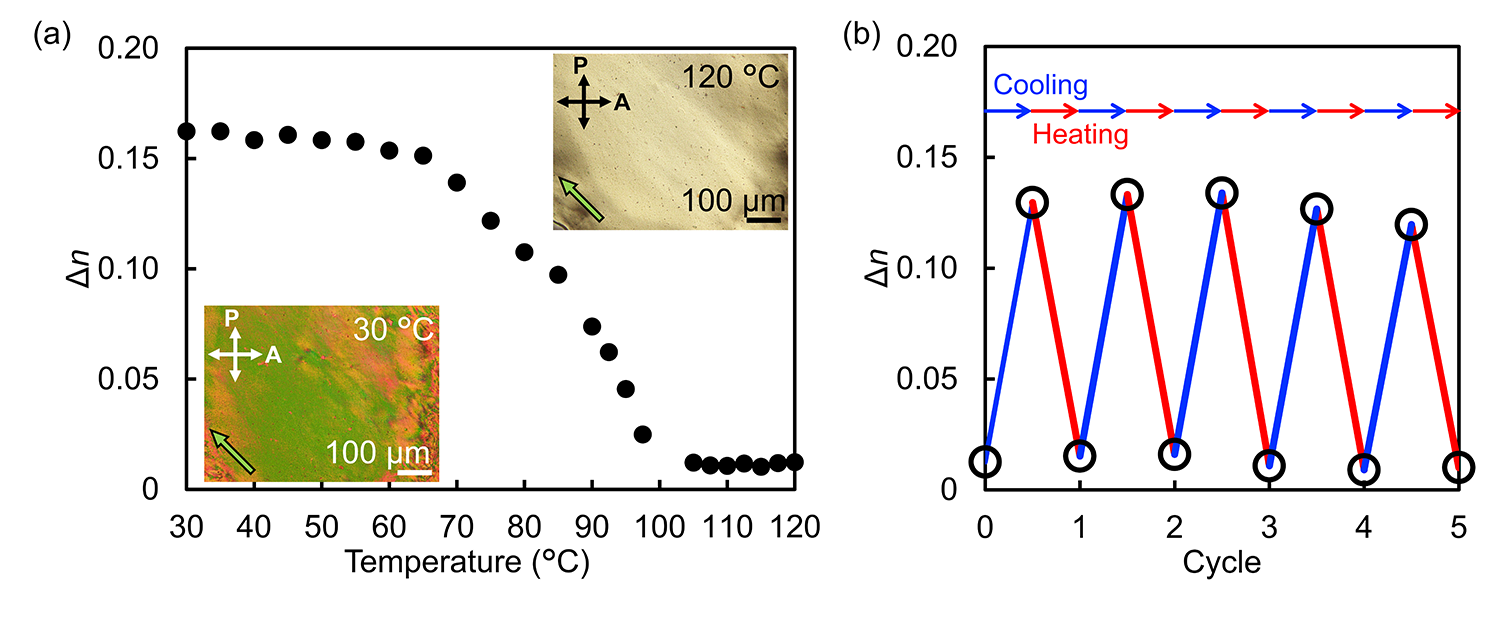
When the optical anisotropy of the film was monitored during heating, the birefringence (Δn) gradually decreased with increasing temperature and then dropped sharply near the LC-isotropic phase transition of the LC polymer. However, the birefringence did not completely disappear even above the phase-transition temperature (Fig. 1a). Because the birefringence originating from the LC polymer vanishes in the isotropic phase, the residual optical anisotropy is attributed to the aligned ZnO nanorods. Upon cooling, the birefringence recovered to nearly its original value, demonstrating a reversible change in optical anisotropy during heating and cooling (Fig. 1b).
 |
|
| Fig. 1. | Temperature-dependent optical anisotropy of an LC polymer-grafted ZnO nanorod film. (a) Temperature dependence of birefringence and polarized optical micrographs. Heating rate: 1 °C min−1. Green arrows indicate the shear direction. (b) Reversible changes in birefringence during repeated heating and cooling cycles. Adapted from Nakano et al.[1] under CC BY 4.0. |
In general, uniaxially aligned films composed of linear LC polymers lose their molecular alignment when heated to the isotropic phase. Upon subsequent cooling, they form polydomain structures and do not recover macroscopically uniform birefringence. The behavior observed in this study resembles the memory effect typically found in cross-linked LC polymers. Thus, this material represents a new system in which an alignment memory effect is achieved through a pseudocross-linked structure despite the absence of chemical cross-linking.
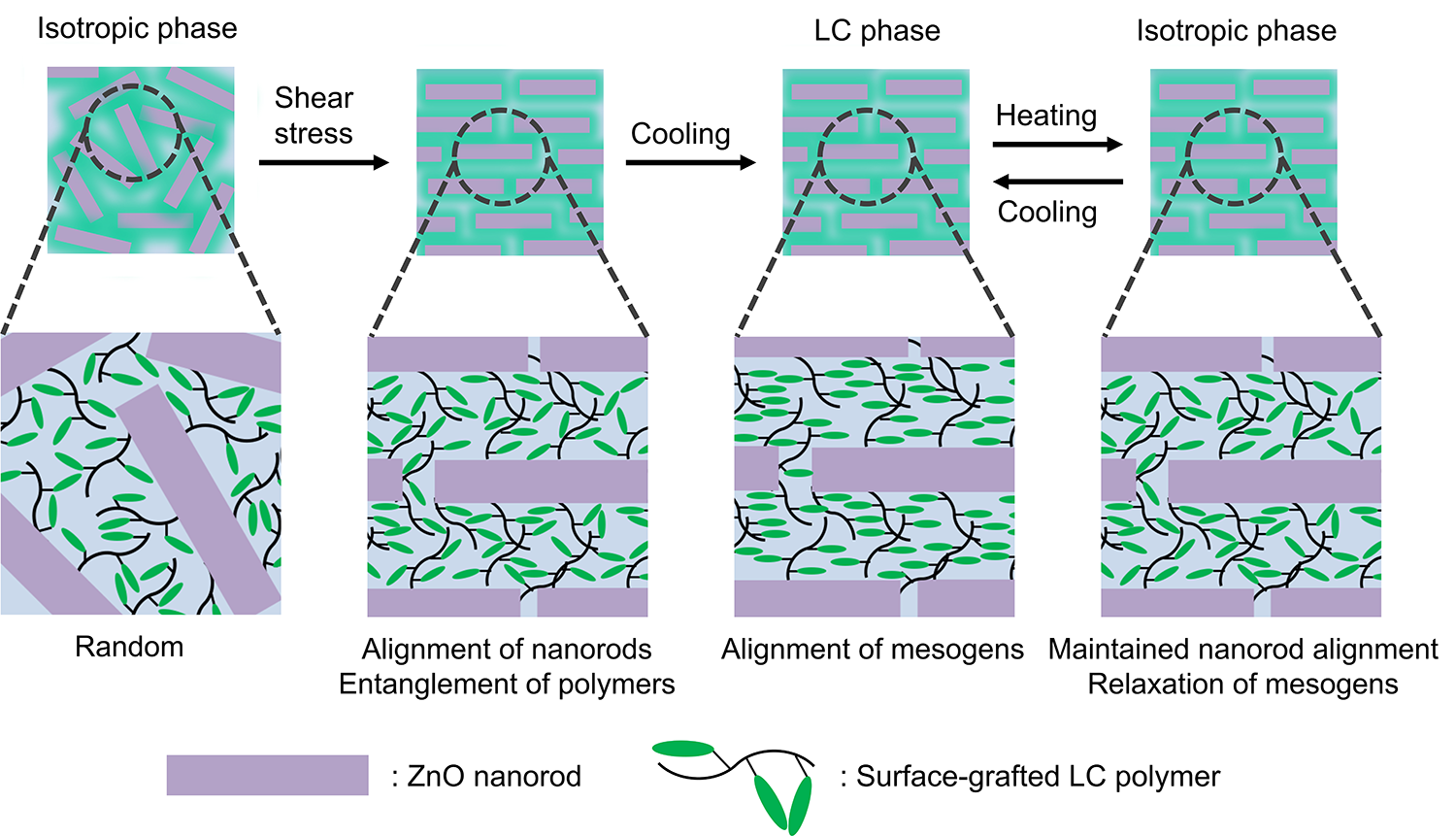
A schematic illustration of the proposed alignment behavior of the shear-aligned LC polymer-grafted nanorod film is shown in Fig. 2. When shear stress is applied at 120 °C, where the grafted LC polymers are in the isotropic phase, the ZnO nanorods align along the shear direction, while entanglement occurs among the grafted polymer chains between nanorods. Upon gradual cooling into the LC phase, the polymer main chains and mesogens align along the shear direction through the combined effects of nanorod alignment and polymer-chain entanglement. When the film is reheated to the isotropic phase, the mesogen alignment relaxes, whereas the alignment of the ZnO nanorods and the entanglement of the polymer main chains are maintained. As a result, the mesogens realign along the nanorods during subsequent cooling.
 |
|
| Fig. 2. | Schematic illustration of the proposed alignment behavior of an LC polymer-grafted ZnO nanorod film. Adapted from Nakano et al.[1] under CC BY 4.0. |
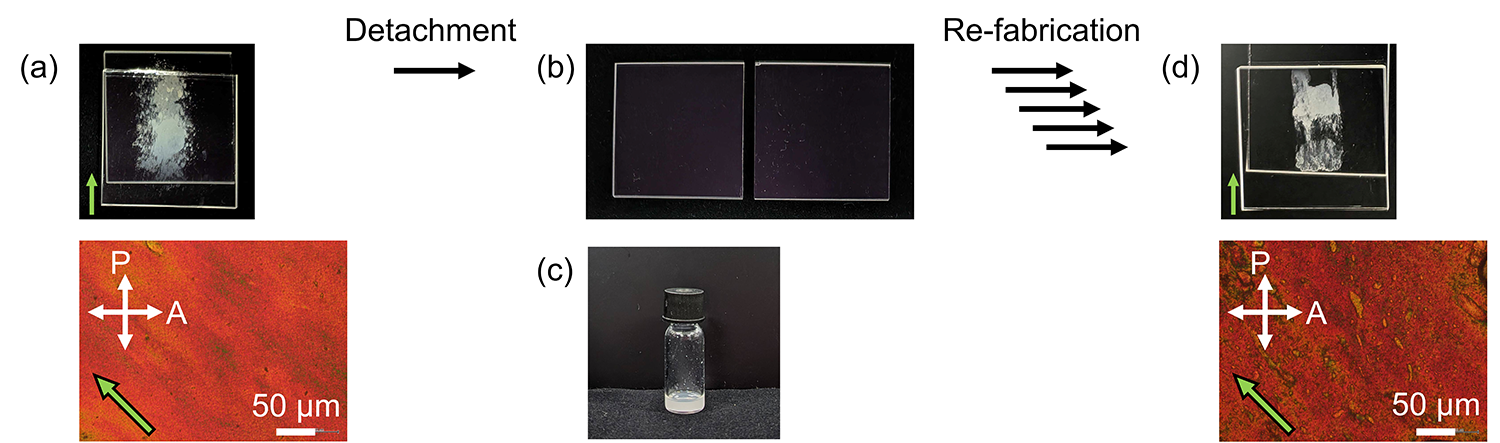
Because this material contains no chemical cross-links covalently connecting the polymer chains, it can retain alignment stability while remaining dispersible in solvent. Taking advantage of this feature, we examined the recyclability of the films. An aligned film was detached from the substrate, redispersed in solvent, and refabricated on another substrate by applying shear stress. Even after this process was repeated five times, the refabricated films retained optical anisotropy comparable to that of the original film (Fig. 3). This recyclability is a distinct advantage over materials containing permanent chemical cross-links.
 |
|
| Fig. 3. | Recyclability of an LC polymer-grafted ZnO nanorod film. (a) Photograph and polarized optical micrographs of the initial film, (b) substrates after film detachment, (c) dispersion of the detached material, and (d) photograph and polarized optical micrographs of the film after five recycling cycles. Green arrows indicate the shear direction. Adapted from Nakano et al.[1] under CC BY 4.0. |
This study demonstrates that anisotropic inorganic nanorods can serve as structural elements for stabilizing molecular alignment, thereby combining the alignment stability characteristic of cross-linked materials with the recyclability of linear polymers. This materials design concept, which enables alignment memory together with dissolution and refabrication without chemical cross-linking, may provide a new route toward recyclable optical films, functional coatings, and reconfigurable polymer materials.
|
Reference |
|
| [1] | K. Nakano, M. Aizawa, K. Hisano, Y. Naka, T. Fukushima, A. Shishido, S. Kubo, ACS Appl. Polym. Mater. 8, 4705-4712 (2026). DOI: 10.1021/acsapm.5c04522. |
| Related links | |
| ●Shishido-Kubo Group: https://www.cls.iir.isct.ac.jp/division/ | |