
Latest Research
- 2026.06.01
- Nakamura-Okada Group
Boron agents termed GluBs reach previously untreatable tumors
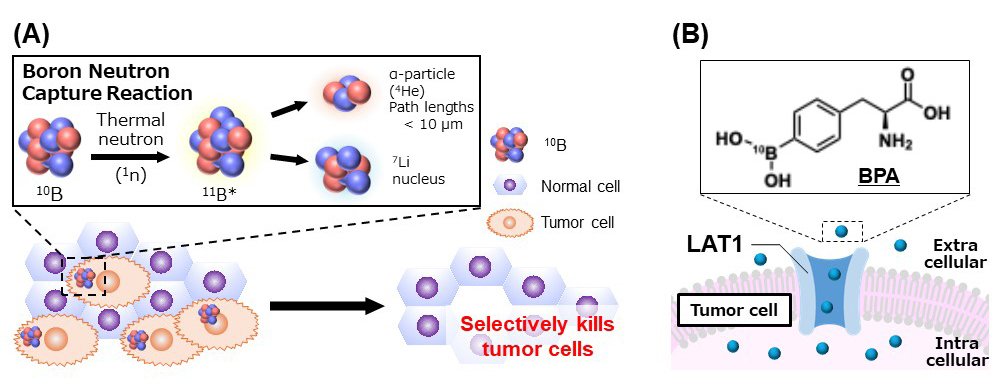
Boron neutron capture therapy (BNCT) is a non-invasive form of radiotherapy that works by delivering enough boron-10 (10B) directly to tumor cells. When these boron-loaded cells are exposed to low-energy neutrons, they release highly localized bursts of energy that destroy the cancer cells while largely sparing nearby healthy tissue (Figure 1A). In current clinical practice, the most widely used boron carrier is 4-borono-L-phenylalanine (BPA). BPA enters tumors primarily through the L-type amino acid transporter 1 (LAT1), a protein that is overexpressed in many cancers (Figure 1B). However, tumors with low LAT1 expression respond poorly, leaving a significant group of patients without effective treatment options and creating an urgent need for boron carriers that utilize alternative uptake pathways. In light of this challenge, we have been developing novel boron agents targeting various proteins that are highly expressed in cancer cells [1,2].
 |
|
| Figure 1. | (A) Overview of boron neutron capture therapy (BNCT). (B) Overview of the BNCT boron carrier 4-borono-L-phenylalanine (BPA), which is transported into tumor cells via L-type amino acid transporter 1 (LAT1). |
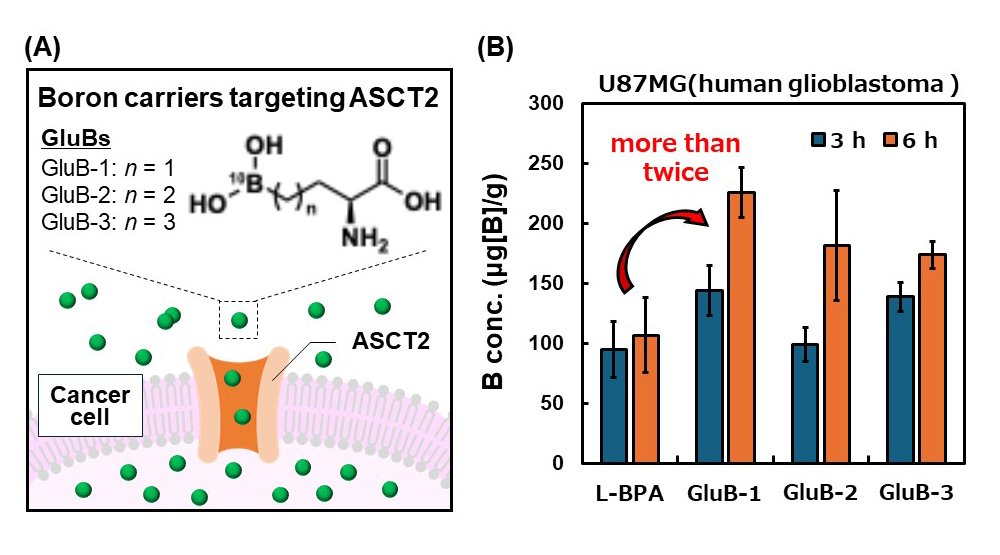
To address this limitation, we developed glutamate-mimicking boron carriers called GluBs. These compounds are designed to enter cancer cells through the alanine-serine-cysteine transporter 2 (ASCT2), a nutrient transporter that supports the metabolic demands of rapidly proliferating tumors (Figure 2A) [3]. we synthesized three related molecules, GluB-1, GluB-2, and GluB-3, each with progressively longer linkers between the amino acid backbone and the boron atom. In laboratory tests, all three dissolved readily in water and showed low toxicity at doses relevant for BNCT, a crucial requirement because such carriers must be administered in relatively large quantities during treatment. When we measured uptake across multiple tumor cell lines, the GluBs preferentially accumulated in cancers with high ASCT2 and low LAT1 expression. The advantage was particularly evident in human glioblastoma cells, which are often resistant to BPA (Figure 2B). Among the candidates, GluB-2 demonstrated the most favorable balance of safety and tumor targeting.
 |
|
| Figure 2. | (A) Overview of the novel BNCT boron agent GluBs targeting alanine-serine-cysteine transporter 2 (ASCT2). (B) Cellular uptake of boron carriers in human glioblastoma U87MG cells with low LAT1 expression and high ASCT2 expression. |
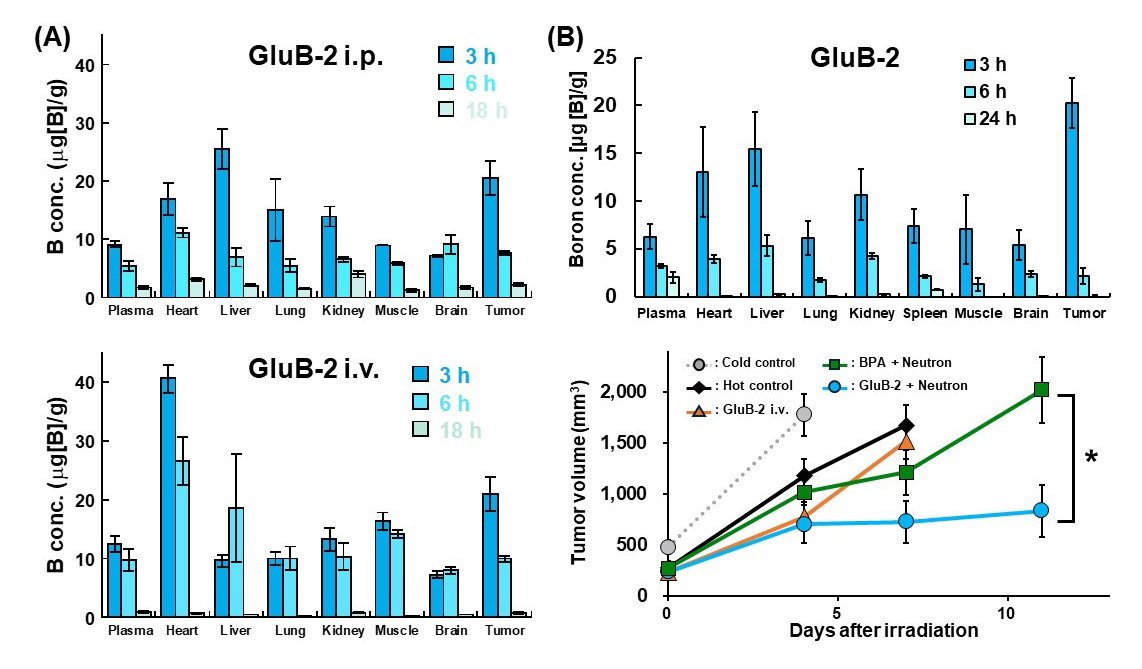
Next, we administered GluB-2 to mouse colon cancer CT26 bearing-mouse model and evaluated boron accumulation in tumors as well as the therapeutic efficacy of BNCT. The results showed that, following both intraperitoneal and intravenous administration, GluB-2 achieved substantially higher intratumoral boron concentrations than BPA (Figure 3A). Furthermore, in an BPA-resistant human glioblastoma U87MG bearing-mouse model, in which BPA fails to accumulate sufficiently, GluB-2 achieved the intratumoral boron concentration required for BNCT (>20 μg 10B/g) and demonstrated marked BNCT efficacy. This effect was significantly greater than that observed in the group treated with the same dose of BPA, suggesting that GluB-2 may serve as a novel boron carrier for BNCT effective against BPA-resistant tumors (Figure 3B). In addition, treated mice maintained stable body weight and showed no apparent damage to major organs throughout the study, supporting the good tolerability and safety profile of GluB-2 at the tested doses.
 |
|
| Figure 3. | (A) Intratumoral accumulation of GluB-2 following different administration routes in mouse colon cancer CT26-bearing mouse model. i.p.: intraperitoneal administration; i.v.: intravenous administration (B) Intratumoral accumulation and BNCT efficacy of GluB-2 in human glioblastoma U87MG-beraring mouse model (BPA-resistant tumor model). |
This study represents the first successful development of ASCT2-targeted boron carriers for BNCT. By utilizing an alternative tumor uptake pathway distinct from LAT1, GluBs may expand the range of tumors that can be effectively treated by BNCT, particularly refractory and recurrent cancers that are resistant to conventional BPA-based therapy.
|
References |
|
| [1] | Miura, K.; Araki, T.; Morita, T.; Nishimura, K.; Okada, S.; Suzuki, M.; Nakamura, H. J. Control. Release 2026, 390, 114566. DOI: 10.1016/j.jconrel.2025.114566 |
| [2] | Kawai, K.; Nishimura, K.; Okada, S.; Sato, S.; Suzuki, M.; Takata, T.; Nakamura, H. Mol. Pharmaceutics 2020, 17, 3740- 3747. DOI: 10.1021/acs.molpharmaceut.0c00478 |
| [3] | Nishimura, K.; Kashiwagi, H.; Morita, T.; Fukuo, Y.; Okada, S.; Miura, K.; Matsumoto, Y.; Sugawara, Y.; Enomoto, T.; Suzuki, M.; Nakai, K.; Kawabata, S.; Nakamura, H. J. Control Release 2023, 360, 249-259. DOI: 10.1016/j.jconrel.2023.06.022 |
| Related Links | |
| ●Science Tokyo News: | |
| Boron agents termed GluBs reach previously untreatable tumors | |
| ●Nakamura-Okada Group: | |
| https://syn.res.titech.ac.jp/en/ | |